Patent Search in Japan: Mastering the Art of Intellectual Property Protection in the Land of the Rising Sun

Patent Attorney in Asia, Patent Lawyer in Asia
patent search in Japan

Patent search Japan

Japan, a country renowned for its technological prowess and innovation, has long been a vital player in the global intellectual property landscape. As such, understanding the intricacies of patent protection in Japan is of paramount importance for businesses and inventors seeking to safeguard their valuable assets.

This article will take you on an enthralling journey through the complexities of conducting a patent search in Japan, exploring the latest developments in the legal landscapeIP policy, and strategies for success. With engaging storytelling and a captivating narrative, we will provide you with the insights and tools needed to navigate the nuances of patent protection in this highly innovative and competitive market.

Click Here for AI Startup Valuation Guide.

Recent Development

The Japan Patent Office (JPO) has been consistently striving to enhance its patent and trademark framework, fostering a more efficient and transparent IP ecosystem. One of the most significant recent developments is the introduction of the “Super Accelerated Examination Program (SAEP)” for patent applications. This program, aimed at expediting the patent examination process, reflects Japan’s commitment to supporting its cutting-edge research and development activities, further solidifying its position as a global innovation leader.

Click Here for AI Startup Valuation Guide.

The patent search process

Conducting a patent search in Japan requires a thorough understanding of the country’s unique legal framework and the effective use of its patent databases. The Japan Patent Office provides online access to its comprehensive databases, which include patents, utility models, industrial designs, and trademarks. However, navigating these databases and interpreting the search results can be challenging for those unfamiliar with the Japanese IP landscape and the relevant legal provisions.

To tackle these challenges, it is crucial to engage the services of a local patent attorney or a professional patent search firm with in-depth knowledge of the Japanese IP system. These experts can guide you through the process, ensuring that your search is thorough and tailored to your specific requirements.

Click Here for AI Startup Valuation Guide.

J-platpat patent search

J-platpat patent search, which stands for the Japan Platform for Patent Information, is a web-based search engine that does not charge users to look through databases of intellectual property information.

It offers information on industrial property, including Japanese publications on patents, utility models, designs, and trademarks that have been issued by the Japan Patent Office (JPO), in addition to various foreign publications.

In addition to this, it offers dossier information from the Japan Patent Office, making it simple to monitor the current status of applications being evaluated by the office.

J-platpat patent search also plays a significant and fundamental role in Japan as a patent information infrastructure. It offers information on industrial property via the internet, and it has improved search functions and a user interface to make it easier for users to find the specific industrial information they are looking for.

Click Here for AI Startup Valuation Guide.

Japanese Patent Search English

To execute a Japanese patent search in English, follow these steps:

Visit the Japan Patent Office (JPO) website at https://www.jpo.go.jp/ and select the “English” button in the upper right corner of the page.

Click on the “Patents” tab in the primary menu at the top of the English version of JPO’s website.

On the “Patents” page, there are several options for searching for patents, including “Patent Search (IPDL)” and “Patent Gazette (PAG)”.

If you select “Patent Search (IPDL),” you will be directed to the Intellectual Property Digital Library (IPDL) search page. Here, you can input search terms in English and select various search parameters to narrow your results.

If you select “Patent Gazette (PAG),” you will be redirected to the Patent Gazette search page, where you can conduct patent searches using keywords, classification codes, and other options.

After entering your search criteria and clicking the “Search” icon, you will be presented with a list of results that correspond to your search terms.

You can click on individual patent numbers to view the entire details of each patent, including the abstract, claims, and drawings.

Note that while a large number of Japanese patents are available in English, some may be accessible only in Japanese. In addition, searching for patents in Japan can be difficult, so it may be beneficial to consult with a patent attorney or agent who is familiar with Japanese patent law and practice.

Click Here for AI Startup Valuation Guide.

A Successful IP Strategy in Japan

Developing a successful IP strategy in Japan requires a deep understanding of the local market, regulations, and enforcement mechanisms. This includes staying informed about the latest legal developments, such as the “Super Accelerated Examination Program (SAEP).” Furthermore, building strong relationships with local partners and leveraging their expertise can be invaluable in navigating the complex Japanese IP landscape.

Click Here for AI Startup Valuation Guide.

In Conclusion,

Patent searches in Japan present a unique set of opportunities and challenges for patent and trademark attorneys. By staying up-to-date on the latest legal developments and adopting a strategic approach, you can effectively navigate the complexities of Japanese intellectual property protection, securing your valuable assets in this dynamic and innovative market. With an engaging narrative and expert insights, this article equips you with the knowledge and tools necessary for success in the realm of Japanese patents and trademarks.

Click Here for AI Startup Valuation Guide.

Our team of advanced patent attorneys assists clients with patent searches, drafting patent applications, and patent (intellectual property) agreements, including licensing and non-disclosure agreements.

Advocate Rahul Dev is a Patent Attorney & International Business Lawyer practicing Technology, Intellectual Property & Corporate Laws. He is reachable at rd (at) patentbusinesslawyer (dot) com & @rdpatentlawyer on Twitter.

Quoted in and contributed to 50+ national & international publications (Bloomberg, FirstPost, SwissInfo, Outlook Money, Yahoo News, Times of India, Economic Times, Business Standard, Quartz, Global Legal Post, International Bar Association, LawAsia, BioSpectrum Asia, Digital News Asia, e27, Leaders Speak, Entrepreneur India, VCCircle, AutoTech).

Regularly invited to speak at international & national platforms (conferences, TV channels, seminars, corporate trainings, government workshops) on technology, patents, business strategy, legal developments, leadership & management.

Working closely with patent attorneys along with international law firms with significant experience with lawyers in Asia Pacific providing services to clients in US and Europe. Flagship services include international patent and trademark filings, patent services in India and global patent consulting services.

Global Blockchain Lawyers (www.GlobalBlockchainLawyers.com) is a digital platform to discuss legal issues, latest technology and legal developments, and applicable laws in the dynamic field of Digital Currency, Blockchain, Bitcoin, Cryptocurrency and raising capital through the sale of tokens or coins (ICO or Initial Coin Offerings).

Blockchain ecosystem in India is evolving at a rapid pace and a proactive legal approach is required by blockchain lawyers in India to understand the complex nature of applicable laws and regulations.

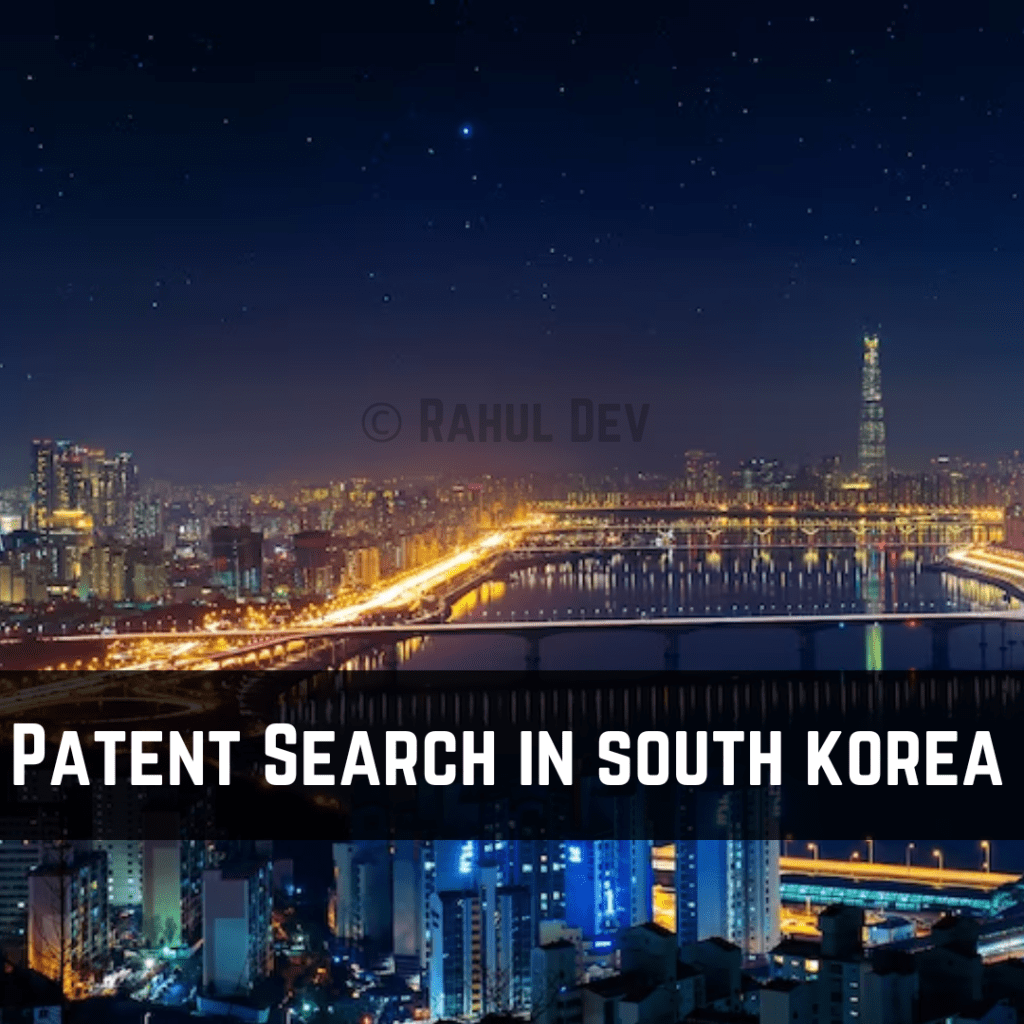
Patent Search in South Korea: Unlocking the Secrets of Intellectual Property Protection in the Land of Innovation

Patent Attorney in Asia, Patent Lawyer in Asia
Patent Search in South Korea

Patent Search: South Korea

South Korea has emerged as a global powerhouse in the fields of technology and innovation, making intellectual property protection increasingly vital for businesses and inventors alike. This article will take you on an enthralling journey through the complexities of conducting a patent search in South Korea, exploring the latest developments in the legal landscapeIP policy, and strategies for success. With engaging storytelling and a riveting narrative, we will provide you with the insights and tools needed to navigate the intricacies of patent protection in this thriving and technologically advanced nation.

Click Here for AI Startup Valuation Guide.

Recent Development

The Korean Intellectual Property Office (KIPO) has proactively enhanced its patent and trademark framework to support the nation’s robust research and development activities. One of the most significant recent developments is the establishment of the “Fast Track Examination System” for patent applications. This system, aimed at expediting the patent examination process, signifies South Korea’s commitment to fostering a more efficient and transparent IP ecosystem, reinforcing its position as a key player in the global IP landscape.

Click Here for AI Startup Valuation Guide.

The Patent Search Process

Conducting a patent search in South Korea requires a thorough understanding of the country’s unique legal framework and efficient use of its patent databasesKIPO provides online access to its comprehensive databases, which include patents, utility models, industrial designs, and trademarks. However, navigating these databases and interpreting the search results can be challenging for those unfamiliar with the Korean IP landscape and the relevant legal provisions.

To overcome these obstacles, it is essential to engage the services of a local patent attorney or a professional patent search firm with in-depth knowledge of the South Korean IP system. These experts can guide you through the process, ensuring your search is comprehensive and tailored to your needs.

Click Here for AI Startup Valuation Guide.

The popular search engine in South Korea

In South KoreaNaver is by far the most popular search engine, surpassing Google there. Before creating and launching its keyword advertising system, Naver was powered by Yahoo’s Overture System. It is currently a well-known search engine with a track record of innovation. Anyone looking to grow their business in South Korea must be familiar with this search engine.

Naver was developed around the language and culture of Korea. Instead of simply translating their material, US-based websites should create a version of their website that is tailored to this culture. Along with the social network Cafe, Naver also makes extensive use of user-generated material in its Knowledge in section. Building a presence in these markets should be the main goal for brands that wish to flourish in Korea.

Click Here for AI Startup Valuation Guide.

Korean trademark search

In accordance with the Trademark Act, trademarks in Korea are protected and must be registered with the Korean Intellectual Property Office (KIPO). To safeguard their brand names for goods and services, anyone—including foreign companies—may be allowed to register their trademarks in the Republic of Korea.

Basic documentation for trademark registration

The following essential informational documents must be submitted to register a trademark in Korea:

Details about the application should include the trademark, the applicant’s name and address (as well as the name of an executive officer if the applicant is a company or legal person), and a list of the chosen products and their classes.

Illustrations and examples of the trademark.

The priory documentation must be submitted if priority is requested.

Passport or corporate certificate copy.

Power of attorney signed.

Priority rights may be claimed by foreign businesses and organizations that initially registered their trademarks in a nation that is a party to the Paris Convention or under a bilateral arrangement with Korea.

In South Korea, a trademark’s legal protection lasts for ten years from the time it was registered and it can be renewed every ten years. An application for the renewal of the trademark registration must be submitted. 

Click Here for AI Startup Valuation Guide.

A Successful IP Strategy in South Korea

Developing a successful IP strategy in South Korea requires a deep understanding of the local market, regulations, and enforcement mechanisms. This includes staying informed about the latest legal developments, such as the “Fast Track Examination System.” Moreover, forging strong relationships with local partners and leveraging their expertise can be invaluable in navigating the complex South Korean IP landscape.

Click Here for AI Startup Valuation Guide.

In Conclusion

Patent search in South Korea presents a unique set of opportunities and challenges for patent and trademark attorneys. By staying abreast of the latest legal developments and adopting a strategic approach, you can effectively navigate the complexities of South Korean intellectual property protection, safeguarding your valuable assets in this vibrant and innovative market. With a captivating narrative and expert insights, this article provides the knowledge and tools necessary for success in the realm of South Korean patents and trademarks.

Click Here for AI Startup Valuation Guide.

Our team of advanced patent attorneys assists clients with patent searches, drafting patent applications, and patent (intellectual property) agreements, including licensing and non-disclosure agreements.

Advocate Rahul Dev is a Patent Attorney & International Business Lawyer practicing Technology, Intellectual Property & Corporate Laws. He is reachable at rd (at) patentbusinesslawyer (dot) com & @rdpatentlawyer on Twitter.

Quoted in and contributed to 50+ national & international publications (Bloomberg, FirstPost, SwissInfo, Outlook Money, Yahoo News, Times of India, Economic Times, Business Standard, Quartz, Global Legal Post, International Bar Association, LawAsia, BioSpectrum Asia, Digital News Asia, e27, Leaders Speak, Entrepreneur India, VCCircle, AutoTech).

Regularly invited to speak at international & national platforms (conferences, TV channels, seminars, corporate trainings, government workshops) on technology, patents, business strategy, legal developments, leadership & management.

Working closely with patent attorneys along with international law firms with significant experience with lawyers in Asia Pacific providing services to clients in US and Europe. Flagship services include international patent and trademark filings, patent services in India and global patent consulting services.

Global Blockchain Lawyers (www.GlobalBlockchainLawyers.com) is a digital platform to discuss legal issues, latest technology and legal developments, and applicable laws in the dynamic field of Digital Currency, Blockchain, Bitcoin, Cryptocurrency and raising capital through the sale of tokens or coins (ICO or Initial Coin Offerings).

Blockchain ecosystem in India is evolving at a rapid pace and a proactive legal approach is required by blockchain lawyers in India to understand the complex nature of applicable laws and regulations.

Patent Search in India: Navigating the Intricacies of Intellectual Property Rights in a Dynamic Market

Patent Attorney in Asia, Patent Lawyer in Asia, Patent Search, Patent Search in Asia, Patent Search in India
Patent Search in India

Patent Search in India

As one of the fastest-growing economies in the world, India presents a plethora of opportunities and challenges for patent and trademark attorneys. With an ever-expanding startup ecosystem and a strong focus on technology and innovation, the protection of intellectual property rights has become more crucial than ever.

This article will take you on a captivating journey through the intricacies of conducting a patent search in India, exploring the latest developments in the legal landscapeIP policy, and strategies for success. Through engaging storytelling and a compelling narrative, we will provide you with the insights and tools necessary to navigate the complexities of patent protection in this vibrant and diverse nation.

Click Here for AI Startup Valuation Guide.

Recent Development

The Indian Patent Office (IPO) has been consistently working towards streamlining its processes, enhancing transparency, and promoting IP awareness. One of the latest milestones is the launch of the “National Intellectual Property Rights Policy,” aimed at fostering innovation, encouraging creativity, and facilitating the commercialization of intellectual property. This comprehensive policy framework is designed to strengthen India’s position as a global innovation hub, highlighting the nation’s commitment to fostering a robust and transparent IP ecosystem.

Click Here for AI Startup Valuation Guide.

The Patent Search Process

Conducting a patent search in India requires a thorough understanding of the country’s unique legal framework and the effective use of its patent databases. The Indian Patent Office provides online access to its comprehensive databases, including patents, trademarks, designs, and geographical indications. However, navigating these databases can be challenging for those unfamiliar with the Indian IP landscape and the relevant legal provisions.

To tackle these challenges, it is crucial to engage the services of a local patent attorney or a professional patent search firm with in-depth knowledge of the Indian IP system. These experts can guide you through the process, ensuring that your search is thorough and tailored to your specific requirements.

Click Here for AI Startup Valuation Guide.

A Successful IP Strategy in India

Developing a successful IP strategy in India requires a deep understanding of the local market, regulations, and enforcement mechanisms. This includes staying informed about the latest legal developments, such as the “National Intellectual Property Rights Policy.” Furthermore, building strong relationships with local partners and leveraging their expertise can be invaluable in navigating the complex Indian IP landscape.

Click Here for AI Startup Valuation Guide.

Design patent Search India

An Indian design patent covers the elaborate design of a useful object. Industrial design rights include design patents. A design patent solely safeguards an invention’s decorative elements, not its functional components. A utility patent would safeguard the functionality and use of a product. Differentiating between a design patent and other kinds of property can be very difficult. A design patent is given, by USPTO patent law, to anyone who imagines a brand-new, obscure decorative design for a manufactured good. Only the exterior of a product, not its structural or functional components, is protected by a design patent.

With a few exceptions, the application process for design patents is similar to that for other types of patents. If your application for a design patent is accepted after inspection, a notice of allowance will be delivered to you, your agent, or your lawyer, along with a request for an issue fee. A design patent application is far more straightforward than one for a utility patent. The specification is brief and formatted in a certain way. There can be only one claim, and it must be in a certain format. The illustrations in a design patent are identical to those in a utility patent, with the exception that decorative features rather than purely functional ones are depicted in design patent drawings.

Click Here for AI Startup Valuation Guide.

Google patent search India

Google Patents is a free patent search engine and database that allows anyone to look up patents and applications from all over the world. As part of its dedication to enhancing public knowledge and access to patents, Google introduced it in 2006. One of the reasons Google Patents is a popular option for patent searchers is its user-friendly design, sophisticated search capabilities, and integration with other Google services.

Follow these steps to run a Google patent search in India:

Visit the Patents Search page of Google (https://patents.google.com/).

Enter the pertinent search terms for the patent you’re looking for in the search box. You may type in the invention’s name or the patent number, for instance.

In the upper-right corner of the page, click the gear symbol.

From the drop-down box, choose “Advanced search.”

Choose “India” from the drop-down selection in the “Legal Status” column.

By adding further parameters, such as the publication date range, the name of the inventor, the name of the assignee, and others, you can further focus your search.

To view the results, click the “Search” button.

Click Here for AI Startup Valuation Guide.

In Conclusion:

Patent searches in India present a unique set of opportunities and challenges for patent and trademark attorneys. By staying up-to-date on the latest legal developments and adopting a strategic approach, you can effectively navigate the complexities of Indian intellectual property protection, securing your valuable assets in this dynamic and growing market. With an engaging narrative and expert insights, this article equips you with the knowledge and tools necessary for success in Indian patents and trademarks.

Click Here for AI Startup Valuation Guide.

Our team of advanced patent attorneys assists clients with patent searches, drafting patent applications, and patent (intellectual property) agreements, including licensing and non-disclosure agreements.

Advocate Rahul Dev is a Patent Attorney & International Business Lawyer practicing Technology, Intellectual Property & Corporate Laws. He is reachable at rd (at) patentbusinesslawyer (dot) com & @rdpatentlawyer on Twitter.

Quoted in and contributed to 50+ national & international publications (Bloomberg, FirstPost, SwissInfo, Outlook Money, Yahoo News, Times of India, Economic Times, Business Standard, Quartz, Global Legal Post, International Bar Association, LawAsia, BioSpectrum Asia, Digital News Asia, e27, Leaders Speak, Entrepreneur India, VCCircle, AutoTech).

Regularly invited to speak at international & national platforms (conferences, TV channels, seminars, corporate trainings, government workshops) on technology, patents, business strategy, legal developments, leadership & management.

Working closely with patent attorneys along with international law firms with significant experience with lawyers in Asia Pacific providing services to clients in US and Europe. Flagship services include international patent and trademark filings, patent services in India and global patent consulting services.

Global Blockchain Lawyers (www.GlobalBlockchainLawyers.com) is a digital platform to discuss legal issues, latest technology and legal developments, and applicable laws in the dynamic field of Digital Currency, Blockchain, Bitcoin, Cryptocurrency and raising capital through the sale of tokens or coins (ICO or Initial Coin Offerings).

Blockchain ecosystem in India is evolving at a rapid pace and a proactive legal approach is required by blockchain lawyers in India to understand the complex nature of applicable laws and regulations.

patent search in china

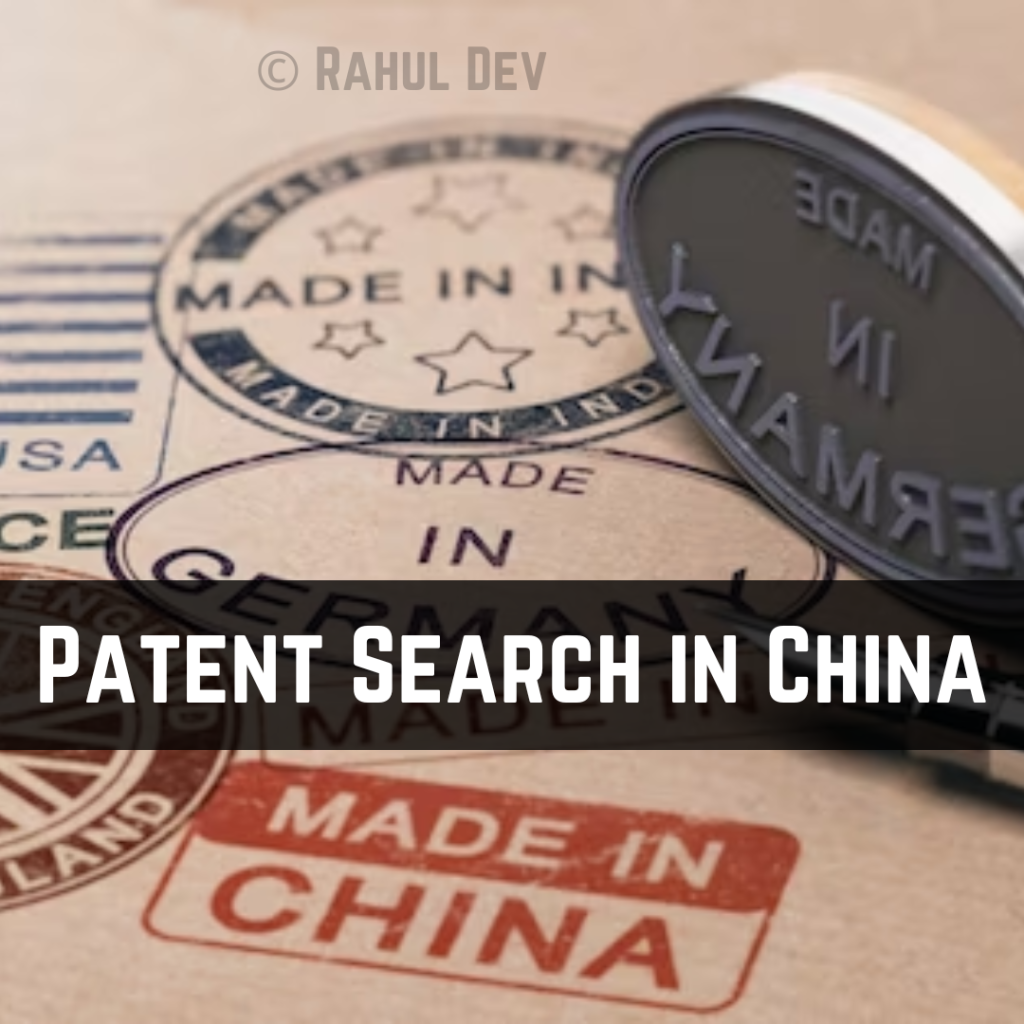
Patent Search in China: Unravelling the Complexities of Intellectual Property Protection

Business in China, Patent Attorney in Asia, Patent Lawyer in Asia, Patent Search, Patent Search in Asia
Patent Search in China

Patent Search China

In today’s rapidly evolving technological landscape, the importance of securing and protecting intellectual property rights cannot be overstated. China, with its booming economy and growing reputation as a global innovation powerhouse, has become a focal point for patent and trademark attorneys worldwide. This article will delve into the intricacies of conducting a patent search in China, highlighting the latest developments in the Chinese legal landscape, IP policy, and key strategies for success. With an engaging narrative and captivating storytelling, we will take you through the maze of Chinese intellectual property law, helping you navigate the complexities of patent protection in the world’s most populous nation.

Click Here for AI Startup Valuation Guide.

Recent Development

China’s National Intellectual Property Administration (CNIPA), formerly known as the State Intellectual Property Office (SIPO), has been making significant strides in bolstering its patent and trademark framework. The recent implementation of the Fourth Amendment to the Patent Law has introduced noteworthy changes, with new provisions aimed at strengthening enforcement mechanisms, optimizing IP services, and promoting the commercialization of innovations. This development is a testament to China’s commitment to creating a more robust and transparent IP ecosystem, positioning itself as a key player in the global IP landscape.

Click Here for AI Startup Valuation Guide.

The Patent Search Process

Embarking on a patent search in China requires a thorough understanding of the country’s unique legal framework and a methodical approach to navigating its vast databases. The CNIPA provides online access to its patent databases, allowing users to search for patents, utility models, industrial designs, and trademarks. However, the language barrier and the sheer volume of the available information may prove challenging for those unfamiliar with the Chinese legal and patent systems.

To overcome these hurdles, it is crucial to engage the services of a local patent attorney or a professional patent search firm with in-depth knowledge of the Chinese IP landscape. These professionals can guide you through the process, ensuring that your search is comprehensive and tailored to your specific needs.

Click Here for AI Startup Valuation Guide.

Filing Requirements in China

Chinese is the official language of China. The application must be translated into Chinese at the time of submission; late filing is not an option. The Chinese Intellectual Property Administration must be given the information and application documents for the applicant and inventor to receive a filing date.

Within three months of the filing date, the power of attorney must be presented with a simple signed copy.

Within sixteen months of the earliest priority date, a certified copy of the priority document is required. Chinese translations of the priority document’s title are required.

When submitting a patent application, it is not essential to include the assignment deed between the applicant(s) and inventor(s).

Click Here for AI Startup Valuation Guide.

Examination of a Chinese patent application

In China, formal and substantive exams are performed on patent applications. The request for a substantive examination must be submitted within three years of the filing date or, in the case of priority, the priority date, whichever comes first.

Click Here for AI Startup Valuation Guide.

Novelty grace period

The publication of knowledge regarding an invention within six months of filing in China does not refute its novelty if:

In the event of a national emergency, the disclosure was made in the public interest; It is initially displayed at an international exhibition that the Chinese government sponsored or recognized; – It is first made public at a specified academic or technological forum; it is revealed by anyone without the applicant’s permission.

Click Here for AI Startup Valuation Guide.

Grant, validity term, and how much does a patent search cost?

In China, patents are valid for twenty years after the filing date. At registration, the first annual charge is due. Before the anniversary of the filing date, all ensuing annual fees must be paid in full. Within a grace period of six months, late payments are permitted with a corresponding cost.

Click Here for AI Startup Valuation Guide.

The length of the registration process

In China, the process takes an average of three years to complete.

Click Here for AI Startup Valuation Guide.

Utility Model

Utility model inventions may also be legally protected in China as utility models, which are only subject to official review. A utility model cannot be converted into a patent application, and vice versa. In China, utility models must be given for innovative and useful technical solutions that are appropriate for everyday usage and relate to a product’s design, structure, or combination of these.

In China, a utility model’s maximum patent protection duration is ten years from the date of filing.

Click Here for AI Startup Valuation Guide.

Patent attorney representation

Foreign applicants must use an agent, a Chinese patent attorney registered with the China National Intellectual Property Administration, to conduct patent prosecution in China.

Click Here for AI Startup Valuation Guide.

A Successful IP Strategy in China

Developing a successful IP strategy in China requires a comprehensive understanding of the local market, relevant regulations, and enforcement mechanisms. This includes staying up-to-date on the latest legal developments, such as the recently implemented Fourth Amendment to the Patent Law. Moreover, forging strong relationships with local partners and leveraging their expertise can prove invaluable in navigating the complex Chinese IP landscape.

Click Here for AI Startup Valuation Guide.

In Conclusion

Patent search in China presents a unique set of challenges and opportunities for patent and trademark attorneys. By staying abreast of the latest legal developments and adopting a strategic approach, you can effectively navigate the complexities of Chinese intellectual property protection, safeguarding your valuable assets in this dynamic and growing market. With a captivating narrative and expert insights, this article provides the knowledge and tools necessary for success in Chinese patents and trademarks.

Click Here for AI Startup Valuation Guide.

Our team of advanced patent attorneys assists clients with patent searches, drafting patent applications, and patent (intellectual property) agreements, including licensing and non-disclosure agreements.

Advocate Rahul Dev is a Patent Attorney & International Business Lawyer practicing Technology, Intellectual Property & Corporate Laws. He is reachable at rd (at) patentbusinesslawyer (dot) com & @rdpatentlawyer on Twitter.

Quoted in and contributed to 50+ national & international publications (Bloomberg, FirstPost, SwissInfo, Outlook Money, Yahoo News, Times of India, Economic Times, Business Standard, Quartz, Global Legal Post, International Bar Association, LawAsia, BioSpectrum Asia, Digital News Asia, e27, Leaders Speak, Entrepreneur India, VCCircle, AutoTech).

Regularly invited to speak at international & national platforms (conferences, TV channels, seminars, corporate trainings, government workshops) on technology, patents, business strategy, legal developments, leadership & management.

Working closely with patent attorneys along with international law firms with significant experience with lawyers in Asia Pacific providing services to clients in US and Europe. Flagship services include international patent and trademark filings, patent services in India and global patent consulting services.

Global Blockchain Lawyers (www.GlobalBlockchainLawyers.com) is a digital platform to discuss legal issues, latest technology and legal developments, and applicable laws in the dynamic field of Digital Currency, Blockchain, Bitcoin, Cryptocurrency and raising capital through the sale of tokens or coins (ICO or Initial Coin Offerings).

Blockchain ecosystem in India is evolving at a rapid pace and a proactive legal approach is required by blockchain lawyers in India to understand the complex nature of applicable laws and regulations.
Machine Learning Patent Landscape in Asia

Business in Malaysia, Business in Singapore, Business in United States, Business Management Services, Lawyers in Asia, Legal Counsel in Malaysia, Malaysian Patent Lawyer, Patent Agent in Malaysia, Patent Attorney in Asia, Patent Filing in Asia, Patent Filing in China, Patent in Asia, Patent Lawyer in Asia, Patent Search, Patent Search in Asia, Patent Search in India, Uncategorized

Machine Learning Innovations in Asia

Recently, Celcom Axiata and Cisco have partnered together to improve mobile connectivity across Malaysia through the implementation of artificial intelligence (AI) and machine learning technology innovations in Asia Pacific. This would be accomplished through the joint efforts of both companies. The updates are centred on the integrated software-defined network (SDN) transport infrastructure that is scheduled to be deployed in future. This will be done with the intention of “substantially improving” the service provisioning time for “businesses of all sizes as well as consumers.”

To understand how machine learning innovations in Asia Pacific are impacting the international economy, look at what APAC is doing to make their sectors successful. Less visible industries are equally ready for innovation as high-tech fields, including machine learning innovations that are filed as machine learning patents by machine learning patent attorneys in Asia, including machine learning patent attorney in Malaysiamachine learning in Singapore, and the like. The spread of mobile phones in Asia-Pacific is changing the banking sector, which effectively uses machine learning. Smartphone and tablet use is rising throughout the region. 

← Back

Thank you for your response. ✨

In Asia, technological and scientific advances have advanced innovations based on machine learning and artificial intelligence. Most countries lag behind in these areas. Lower original creativity and ineffective technology exchange policies are to blame. Also, implementing a machine learning innovation landscape in Asia-Pacific countries has increased investment and MNC involvement. As an example, Tsinghua University in China has surpassed Korea’s POSTECH as the region’s most innovative university. The Chinese institution vaulted three ranks to become Japan and China’s top university. The results match Japan’s overall performance on Reuters’ lists of innovative universities.   

machine learning patent drafting

Asia-Pacific innovation also includes Fintech Labs. Companies can try new ideas and improve machine learning processes in these collaborative spaces. Busan Daily employed AI to study its audience’s preferences and deliver customised onsite search. It’s also building community tools and standards. These measures, together with more platform services, will be vital to regional success. Digital transformation based on machine learning will drive future innovation in Asia-Pacific. A review of Machine Learning Patent Landscape in Asia provides insights on strong AI patents and ML patents drafted by patent attorneys in Asia, which include enforceable patent claims.

Machine Learning Patent Example

Nowadays, many companies are opting for a patent related to machine learning to gain control over the market. In terms of ML basics, inventors understand that there exist three types of machine-learning mainly, including, supervised learningunsupervised learning, and reinforcement learning. For example, to provide exact and short answers to its users, Google has recently patented a machine-learning algorithm to include rich media for a specific type of answers and provide the best results for voice searches. Similarly, Amazon has filed a patent to capture details of conversations happening around its smart device Alexa and record them. After analyzing such data, it shall be used for advertising purposes. On the other hand, Samsung has filed a patent for a drone that is controlled via hand gestures and facial recognization to project customized ads to its customers. This drone comes with a flying display with the ability to detect a person’s hand gestures, face, and pupils. 

Many countries have been debating over the process to determine the scope of examination standards and legal protection in case innovation created by ML is granted a patent right. Another question is what the scope of patent rights for the inventions should be that AI creates and involves the determination of examination standards along with the scope of restrictions and authorizations. Similarly, lawmakers are pondering over what should be the legal status of the invention that AI creates or how to treat the relationship between a general inventor, ML inventor, and ML as an inventor. The third question is regarding the distribution of innovation that ML creates, i.e., distribution and redistribution benefits for ML investors, ML owners, and the public. 

Machine Learning Innovations

The machine learning invention is an information product that also covers the legitimacy of property in market value. The patent system should assist such innovators to coordinate the balance between transaction security and freedom that the innovation market provides. The patent system must provide a normative approach for machine learning inventions and clarify the patentability of innovations to create sustainable development of the computer-human collaborative approach in the ongoing technology era. 

Machine Learning Patent FAQs

Here are few important frequently asked questions pertaining to machine learning patents.

​​Can you patent a ML model?

patent for a machine learning model will contain certain components. It will contain the title of the invention, its description, claims, and the name of one or more inventors. A patent will also identify the patent assignee, which is a person who owns the rights to the invention. A patent for a machine learning model is a complex process. If you want to protect your creation, it is important to follow the proper procedures.

First, inventors should file a patent for a machine learning model only if it can be used to identify patentable ideas. Patent office examiners are required to search for patents using their skills, and machine learning could help them focus on higher-level tasks. While large software companies have been patenting artificial intelligence-related technologies for decades, startups in fields outside of the software sector are quickly taking advantage of the technology. Adaptability: Another key aspect of a patent for a machine learning model is the ability to make the algorithm fit the specific technical implementation. Adaptation to a specific technical implementation means that the algorithm is adapted to the way a computer operates. A neural network training method will consider the features of the computer to determine when to cache information. By utilizing such considerations, an innovation using a machine learning model can be patent-protected.

Are patents good for innovation?

The role of patents in promoting innovation has often been discussed across various forums. CEOs of high-tech companies argue that a patent is essential for their businesses, while economists are less sure. Some researchers have found that patents can hinder innovation (by 13%). That is why it is crucial to understand the role of patents in promoting innovation before making sweeping policy changes. 

Having a patent protects the technology. Patents also promote downstream development through contracts and commercialisation. Patents reduce the gap between science and industrial innovation, enabling new ideas to be reproduced by others. Furthermore, patents can foster the diffusion of knowledge and help facilitate the exploitation and commercialisation of new technologies. 

How do you patent machine learning?

As AI and machine learning become more commonplace, many innovators are seeking ways to protect their work with patents. Patent applications for machine learning and artificial intelligence have increased dramatically in recent years, but patent attorneys have struggled with how to claim these innovations. Luckily, there are a few steps inventors can take to ensure their work remains protected. Below are some key steps that patent attorneys can take to strengthen their machine learning patents.

Patent applications relating to AI and machine learning are essential for scientific discovery, but many technologies are not suited for patent protection. The application process can pose several risks. Some abstract ideas cannot be protected through patents, such as mental processes, methods of organizing human activity, mathematical formulas, or calculations. The government, however, continues to seek input from a range of companies on the topic of AI and machine learning, which can potentially lead to new innovations. 

When pursuing patents for AI and machine learning, inventors should first consider whether their innovation is truly innovative. Patent applications should contain claims, titles, and descriptions. Typically, the machine learning patent will name one or more inventors, as well as the assignee (the person who owns the patent rights).

In addition to the crucial points stated here relating to machine learning patents in Asia Pacific, the future business models based on innovation may regularly need assistance for Patent Searching. The results of a patent search report can assist in determining if Patent Drafting is the next step for International Patent Filing along with USPTO Patent Filing. In case of blockchain based business models, utility token Legal Opinion Letters may also be needed, along with a set of applicable contracts and agreements.

Our team of advanced patent attorneys assists clients with patent searches, drafting patent applications, and patent (intellectual property) agreements, including licensing and non-disclosure agreements.

Advocate Rahul Dev is a Patent Attorney & International Business Lawyer practicing Technology, Intellectual Property & Corporate Laws. He is reachable at rd (at) patentbusinesslawyer (dot) com & @rdpatentlawyer on Twitter.

Quoted in and contributed to 50+ national & international publications (Bloomberg, FirstPost, SwissInfo, Outlook Money, Yahoo News, Times of India, Economic Times, Business Standard, Quartz, Global Legal Post, International Bar Association, LawAsia, BioSpectrum Asia, Digital News Asia, e27, Leaders Speak, Entrepreneur India, VCCircle, AutoTech).

Regularly invited to speak at international & national platforms (conferences, TV channels, seminars, corporate trainings, government workshops) on technology, patents, business strategy, legal developments, leadership & management.

Working closely with patent attorneys along with international law firms with significant experience with lawyers in Asia Pacific providing services to clients in US and Europe. Flagship services include international patent and trademark filingspatent services in India and global patent consulting services.

Global Blockchain Lawyers (www.GlobalBlockchainLawyers.com) is a digital platform to discuss legal issues, latest technology and legal developments, and applicable laws in the dynamic field of Digital Currency, Blockchain, Bitcoin, Cryptocurrency and raising capital through the sale of tokens or coins (ICO or Initial Coin Offerings).

Blockchain ecosystem in India is evolving at a rapid pace and a proactive legal approach is required by blockchain lawyers in India to understand the complex nature of applicable laws and regulations.
Role of DeFi Attorney and FinTech Lawyer in Asia

Patent Attorney in Asia, Patent Lawyer in Asia, Technology Business Consultants

FinTech Laws in Asia 

FinTech Lawyers and DeFi Attorneys work on due diligence projects and legal opinion letters for blockchain projects. In recent years, the region has begun to see an explosion in FinTech companies, but the regulation in many countries can be confusing. The MAS and Enterprise Singapore are the main regulatory bodies in the region, and the Moneylenders Act regulates the moneylending business. The Philippines and Thailand have not yet signed the Memorandum of Cooperation between their governments or signed the APEC FinTech Funds Passport negotiations.  

← Back

Thank you for your response. ✨

While the regulatory framework in most countries is fairly flexible, it will take time to implement. The current timeframe for implementing new regulations in Asia is two to three years. In the meantime, many companies are unable to launch their services in the region due to regulatory gaps. The MAS has taken action against some errant FinTech players, penalizing them in virtual money. Additionally, it has imposed strict rules on digital token exchanges, such as those of Coincheck. In May 2018, the MAS issued warnings to eight digital token exchanges in the country for facilitating trading in deemed securities and futures contracts.  

fintech attorney

Regulatory fragmentation is another reason for the low level of mutual recognition of licensing requirements. As a result, most ASEAN countries restrict foreign entities from offering financial services to consumers. For example, in Indonesia, all e-money operators must be 49% foreign-owned. In Thailand, a recent decree on digital assets businesses restricts foreign ownership of e-money operators. In Singapore, the Payment Services Act (PSA) requires platform operators to check the affordability of their customers.  In addition to the lack of mutual recognition of licensing requirements, many ASEAN nations restrict foreign entities from providing financial services. In Indonesia, all e-money operators must be 49% foreign-owned. In Thailand, the 2018 Payment Services Act also limits foreign ownership in the sector. These are just some of the major challenges in the region. There are more than a few challenges ahead. But, with the continued development of the fintech industry in the region, the future is bright.  

Singapore’s MAS has outlined its principles for FinTech regulation. It has indicated that it is not appropriate to “front run” innovation and has established numerous co-operation agreements with its foreign counterparts to monitor emerging FinTech activities. In Singapore, the MAS monitors and enforces the FinTech landscape, and makes changes as necessary. This is especially true in the case of the Monetary Authority of Singapore, as the regulatory body has the authority to regulate the sector.  In Singapore, FinTech companies are regulated by the MAS. MAS regulates the financial services industry in the country. Its statutory legislation governs various aspects of financial institutions, including data security and privacy. The ICOs are often regulated by the MAS. This is why they are required to comply with such regulations. However, in Asia, the MAS has not yet been fully effective in regulating the FinTech industry. Within Asia Pacific, role of Fintech Attorneys and Decentralized Finance or DeFi lawyers includes FinTech or DeFi due diligence and writing DeFi legal opinion letters or Fintech legal opinion letters.

In Singapore, the MAS is responsible for regulating the financial sector and managing risks. In particular, Singapore is a leader in FinTech. Despite its success, Singapore is also a global financial center. The MAS regulates the financial sector in the country and is particularly concerned with cybersecurity. The MAS has recently signed agreements with several foreign regulators to regulate the industry and prevent cybercrime. Further, the MAS has a strong cybersecurity law in Singapore.  The regulatory landscape in the region is evolving rapidly. While there are many differences between countries, overlapping national regulations can lead to a disproportionately high level of compliance costs and delays in implementing new technologies. By following these guidelines, Asian regulators will ensure that financial services remain competitive and safe. There will be more innovation in the region in FinTech and the industry is likely to grow exponentially. If this trend continues, the region will continue to thrive in the future.  Regulatory issues in Asia are growing rapidly. China is the most important market for FinTech and is a burgeoning global marketplace. While the region is diverse and dynamic, it is a crucial part of the world. But, as with any industry, regulations are constantly changing. This can affect businesses in any part of the region. Consequently, it is imperative to stay abreast of the latest developments in the region to stay on top of local laws.

Our team of advanced patent attorneys assists clients with patent searches, drafting patent applications, and patent (intellectual property) agreements, including licensing and non-disclosure agreements.

Advocate Rahul Dev is a Patent Attorney & International Business Lawyer practicing Technology, Intellectual Property & Corporate Laws. He is reachable at rd (at) patentbusinesslawyer (dot) com & @rdpatentlawyer on Twitter.

Quoted in and contributed to 50+ national & international publications (Bloomberg, FirstPost, SwissInfo, Outlook Money, Yahoo News, Times of India, Economic Times, Business Standard, Quartz, Global Legal Post, International Bar Association, LawAsia, BioSpectrum Asia, Digital News Asia, e27, Leaders Speak, Entrepreneur India, VCCircle, AutoTech).

Regularly invited to speak at international & national platforms (conferences, TV channels, seminars, corporate trainings, government workshops) on technology, patents, business strategy, legal developments, leadership & management.

Working closely with patent attorneys along with international law firms with significant experience with lawyers in Asia Pacific providing services to clients in US and Europe. Flagship services include international patent and trademark filingspatent services in India and global patent consulting services.

Global Blockchain Lawyers (www.GlobalBlockchainLawyers.com) is a digital platform to discuss legal issues, latest technology and legal developments, and applicable laws in the dynamic field of Digital Currency, Blockchain, Bitcoin, Cryptocurrency and raising capital through the sale of tokens or coins (ICO or Initial Coin Offerings).

Blockchain ecosystem in India is evolving at a rapid pace and a proactive legal approach is required by blockchain lawyers in India to understand the complex nature of applicable laws and regulations.

Doing Business in Europe | Patent Filing in Europe

Business in Europe, Patent Attorney in Asia, Patent in Asia

Doing Business in Europe

Europe offers an interesting jurisdiction for startups to incorporate a business entity and file patents for innovations. Many entrepreneurs who decide to start a European company often find it quite difficult because of all the red tape that must be jumped through before getting off the ground. Setting up an office in Europe can be very time-consuming. The regulations regarding setting up a company can be quite complicated. There are also legal formalities to fulfill, not to mention taxation to deal with. One must therefore be aware of every aspect of doing business in Europe before jumping into the venture.

patent attorney in europe

Doing Business in Europe was rated fourth by the World Bank for ease of doing business in Europe; fifth globally and fifth in the overall quality of life index. The report looked at different dimensions of the legal environment including the anti-trust laws for establishing a company, getting financing, paying taxes, settling bankruptcy, and labor law regulation amongst many others. Surprisingly, entrepreneurship in Europe did not feature among the factors that were studied. This might be due to different reasons such as the scale at which the industry has grown compared to other countries, or it may also be because entrepreneurship is considered a soft form of innovation.

← Back

Thank you for your response. ✨

No matter how it might be viewed, there is no doubt that startups need technology and that is where the European countries score over the rest of the world. Some of the best European technology companies such as Vivaxa and Skype have grown incredibly large because of the innovations they have brought into the markets. Europe is home to some of the biggest technology firms in the world such as Cisco, EMC, Apple and Google. These firms definitely paved the way for what we call the European technology boom.

In line with innovation and technology, the European countries also score well on business and consumer protection. The European Union’s single market policy and the rules on product pricing and consumer protection helped accelerates startup activity as well as technology development. Consumer protection is especially important because the new industries are mostly based on technology with issues such as data security, privacy and anonymity surfacing. This makes it extremely important to be protected from the threats posed by cyber criminals. It also ensures fair competition between companies, making it easier for customers to choose services and products.

Another factor that was studied was entrepreneurs’ mindset. This is the belief that startups should not look at profit only but should also consider social aspects of being a startup. Being able to think creatively in terms of solving problems is important to innovators. This will encourage more of them to continue building their businesses in the European markets. In the last few years, it seems that European startups are becoming more valued as consumers.

Entrepreneurs also need to consider the corporate tax rates when doing business in Europe. Ireland has a very low corporate tax rate of 6 percent. To take advantage of this you should register your company in Ireland. Companies can employ a local head office and thus avail of low taxes. If you have a European subsidiary, you can avail of European corporate tax benefits.

Companies looking for an innovative solution to their business problems should consider doing business in european countries such as Ireland, Sweden and Finland. By doing so you will benefit from lower corporate tax, liberal trade regulations and a pro-business environment. In order to take advantage of these factors, all you have to do is find an effective business solution. If you decide to do business in european countries like these, it will be easier for you to establish an office, get registered and obtain needed corporate documentation.

Patent Process in Europe

Patents mandate the freedom to prohibit others from exercising an alleged creation, not the freedom to prevent others from utilizing a “power in nature . . . open to all”, with this patent eligibility comes into question. While there is no “one size fits all” strategy to internationally fulfil the standards for patent eligibility, there are several widespread seams, such as the validity or absence of a technical consequence, to accept for deliberation. The regulations for subject matter eligibility for patents and computer-implemented (CI) creations assess concrete limitations on the CI creations that are patentable in the EU jurisdictions. 

The European patent system governs under the European Patent Convention (“EPC”) in which Article 52 interprets patentability – “European patents shall be granted for any inventions which are susceptible of industrial application, which are new, and which involve an inventive step”. This terminology is similar to the patentability regulations comprised in the US laws for the patent-eligible subject matter. Nonetheless, the EPC statutorily limits patentability in Article 52(2) distinguishing mathematical criteria, aesthetic achievements, and demonstrations of data as un-patentable. Also, the Article 53 specifically eliminates from patentability “inventions the commercial exploitation of which would be contrary to ‘order public’ or morality,” “plant or animal varieties, or essentially biological processes,” processes for humans or animals, and diagnostic systems exercised on them.

Patentability Criteria in Europe

The European Patent Convention (EPC) has dictated four Criteria of Patentability. A creation is patentable if, it is novel (Article 54), comprises an inventive step (Article 56), is eligible for industrial application (Article 57), and is not omitted under Article 52(2) and (3).

Novelty: As per the EPC an invention cannot originate from a prior duration in any course, whether a commodity, a method, the data is not accessible to the public whether in European nations or elsewhere in the world.

Inventiveness: As per law, an individual with a normal brain and ability in the composition should not be competent to develop the assertions of the creation. This standard is identical to the US Criteria of non-obviousness.

Industrial Application: Section 4 dictates that creation shall be seized to be eligible for industrial application if it can be rendered or utilized in any aspect of the industry comprising agriculture. This standard is identical to the US Criteria of utility.

The European Patent Convention has no favourable advice on what is deemed a creation for the objectives of patent legislation. Still, it conveys in Article 52(2) a non-exhaustive record of what is not to be considered as inventions, and thus not patentable matter. The following cannot be considered as inventions:

(a) Discoveries, scientific theories, and mathematical methods

(b) Aesthetic creations

(c) Policies, guidelines, and processes for conducting mental acts, games or business, and computer software

(d) Presentation of data

EPO Patent Practice

As per Article 52(1) EPC, “European patents shall be granted for any inventions, in all fields of technology, provided that they are new, involve an inventive step and are susceptible of industrial application.” This brings up four subjects, whether it is an invention, whether the invention is susceptible to industrial application, whether it is novel and does it encompass an inventive step. The initial issue is that the asserted subject-matter is an invention in the domain of patentable subject matter. The invention issue or patentable subject-matter issue foregoes the three additional problems, which need not, be analyzed if there is no invention. The case of the Boards of Appeal of the EPO, looked into the question “Is there an invention?” moreover indicates the additional matter on “Does the asserted subject-matter have a technical element”, possessing a technical element is a tacit regulation of the EPC to be fulfilled by creation to be an invention under Article 52(1) EPC.

Patentable subject-matter references furthermore intervene at an auxiliary degree, in the inventive step inspection. In EPC dictates that a creation comprising of a mix of specialized and non-technical characteristics and possessing technical identity in its entirety is to be evaluated for the condition of inventive step by accepting all characteristics which participate to the technical identity whereas details generating no contribution cannot aid the dignity of inventive step. The non-technical details are prohibited from the sphere of patentable subject-matter as an issue of agreement. 

This test for patentable subject-matter dictates that a petition or patent which does not deliver a technical outcome to a technical problem would be declined (Article 97(1) or rescinded (Article 102(1) as requiring inventive step.

The EPO fulfills plans for assessing the patent-eligibility of Computer-Implemented Inventions (CII), particularly established on Artificial Intelligence (AI). For example, AI image programs are deemed technical and accordingly patent-eligible. Contrarily, AI text programs with a text category only founded on the subject of the article are not deemed technical. These are prohibited from patentability as attaching importance to words is a cognitive assignment and not a technical undertaking.

The Unitary Patent

The Commission is enthusiastic in the execution of a patent package. When it is inaugurated it founded a European patent with unitary effect and a recent patent court. The unitary patent is a legitimate title that will furnish uniform insurance across all contributing nations in a step, contributing large cost benefits and decreasing administrative limitations. The package can initiate a Unified Patent Court that will request a sole jurisdiction with restricted competence over European patent prosecution.

Utility Model in Europe

A utility criterion is registered freedom that provides the holder undivided practice of a technical invention. There is no EU-wide utility criterion insurance, the Commission surveys the monetary effect of utility model regulation.

Supplementary Protection Certificates

Supplementary protection certificates (SPCs) serve as an addition to patent freedom established by EU laws to equalize the penalty of patent safety for pharmaceutical and plant protection commodities that arise due to the prolonged trials these commodities need before to obtaining regulatory marketing authorization.

Biotechnological Inventions

The laws on the extent and constraints of patent insurance for biotechnological creations are harmonized in the EU by Directive 98/44/EC on the legal safety of biotechnological creations. They contain biological substances or procedures through which biological substance is generated, refined, or utilized. These are patentable if they fulfil the common conditions for patentability, i.e. novelty, inventiveness, and industrial applicability.

Patents for Industrial Innovation

Exploitation of IP for industrial innovation tested the method of a policy device that boosts the possibility of modern business growth founded on exterior IP accession, encompassing new patented inventions. It indicated that a policy tool can be formulated to boost the aim of exterior IP by Small and Medium-Sized Enterprises (SMEs) concentrating on perception and agreement costs. Further, it is not probable to formulate a policy concentrated solely on stagnant patents. It can execute the tool at a domestic degree as SME aid is governed at these categories and it requires the advantages inherent in the vicinity.

Our team of advanced patent attorneys assists clients with patent searches, drafting patent applications, and patent (intellectual property) agreements, including licensing and non-disclosure agreements.

Advocate Rahul Dev is a Patent Attorney & International Business Lawyer practicing Technology, Intellectual Property & Corporate Laws. He is reachable at rd (at) patentbusinesslawyer (dot) com & @rdpatentlawyer on Twitter.

Quoted in and contributed to 50+ national & international publications (Bloomberg, FirstPost, SwissInfo, Outlook Money, Yahoo News, Times of India, Economic Times, Business Standard, Quartz, Global Legal Post, International Bar Association, LawAsia, BioSpectrum Asia, Digital News Asia, e27, Leaders Speak, Entrepreneur India, VCCircle, AutoTech).

Regularly invited to speak at international & national platforms (conferences, TV channels, seminars, corporate trainings, government workshops) on technology, patents, business strategy, legal developments, leadership & management.

Working closely with patent attorneys along with international law firms with significant experience with lawyers in Asia Pacific providing services to clients in US and Europe. Flagship services include international patent and trademark filingspatent services in India and global patent consulting services.

Global Blockchain Lawyers (www.GlobalBlockchainLawyers.com) is a digital platform to discuss legal issues, latest technology and legal developments, and applicable laws in the dynamic field of Digital Currency, Blockchain, Bitcoin, Cryptocurrency and raising capital through the sale of tokens or coins (ICO or Initial Coin Offerings).

Blockchain ecosystem in India is evolving at a rapid pace and a proactive legal approach is required by blockchain lawyers in India to understand the complex nature of applicable laws and regulations.

Patent Filing in ASEAN

Patent Attorney in Asia

A patent is an exclusive legal right granted to the applicant for a new invention by the government that prevents from making, using, importing, or selling the invention without his permission. Patent’s rights are territorial, which means an individual can protect his invention in the geography where he filed the patent application. An individual can also obtain international patent protection by directly filing a patent application in the country where he wishes to get a patent. There are three types of patents. These are utility patents, design patents, and plant patents. A utility patent is concerned with the technology and it has to do with how something works. It has to do with mechanical things or chemicals or pharmaceuticals or software, it might be simple, it might be a screw or a nut or a bolt but there is something technical about the product. It could be shown in drawings. It can describe in tables or chemical composition. The utility patent includes a detailed and written description.  Design patent covers the ornamental design. Plant patents are the rarest of all kinds of patents. They are not that hard to get, but they are in a specialized field, typically, for example, for hybrid roses. If you breed hybrid roses, you might be interested in plant patent. 

Patents protect inventive ideas themselves.  In the United States, the patent and trademark office issues patents to inventors who can demonstrate their inventions are new and useful. Patents provide the inventor 20 years period of exclusive control over their idea, preventing anyone else from making, using, selling, or importing the invention into the United States. Patent holders can recover their lost profits or a reasonable royalty from anyone who infringes their patent and up to triple damages from anyone who infringes wilfully. Patent holders can also obtain a court order preventing infringers from making, using, selling, or importing any products based on their patents.

ASEAN is a political and economic alliance of ten countries. The group’s five original member states are Indonesia, Malaysia, The Philippines, Singapore, and Thailand, founded ASAEN in 1967, during the height of the Vietnam war. At that time, many Southeast Asian governments were at war with their respective communist-led guerrilla groups, and leaders became increasingly concerned about political vulnerability. So, they ally to not only secure the region against the threat of communism but to give Southeast Asia a cohesive voice on Cold war issues.

Since the fall of the Soviet Union, ASAEN has shifted its focus to international trade, border security, and collaboration with neighbouring countries like China and South Korea. For instance, ASEAN member state GDP range anywhere from roughly $11 to roughly 888 billion dollars, but collectively their GDP is about 2.5 trillion dollars rivalling that of France and the United Kingdom. ASEAN striving to create a distinct “Southeast Asian identity” by 2020. It means that citizens belonging to these member states would identify themselves not by their nationality, but by calling themselves ASEAN.   

The Southeast Asian Nations (ASEAN) has the goal of establishing itself as a single market and competitive economic region. The Southeast Asian Nations (ASEAN) recognizes the patent system as a tool to persuade and promote a pro-business environment and to attract technological investment to the region. ASEAN can become one of the largest economies and markets in the world, which is in itself is sufficient justification to consider IP strategies in the region. In the future, if ASEAN becomes the single economy, then it would be the seventh-largest in the world and the third-largest in Asia, behind China and Japan. If ASEAN grows with current growth trends, then it will be the world’s fourth-largest by 2050. ASEAN’s potential market is greater than the European Union, which is justification in the region’s GDP growth from the perspective of the population.

The limited institutional capacity and flaws in the patent registration system in ASEAN countries are hurdles for development. ASEAN must adopt another regional model, which is the Regional Patent Office, to remove such barriers and promote the patent registration system in ASEAN. Regional Patent Office gives an advantage to ASEAN in improving its capability in administering the patent registration and promoting the goal of ASEAN to accelerate the technological growth in the region. ASEAN member states must overcome the challenges in establishing the regional Patent Office.  

ASPEC stands for The ASEAN Patent Examination Co-operation which, is launched on 15 June 2009. ASPEC is the first regional patent work-sharing program among its nine participating ASEAN Member states IP Offices. These member states IP Offices are Brunei Darussalam, Cambodia, Indonesia, Lao PDR, Malaysia, The Philippines, Singapore, Thailand, and Vietnam. In all participating AMS IP Offices, ASPEC operates in the English language and is free-of-charge to the applicant at any participating AMS IP Office. The patent office assesses the patentability of a patent application by conducting exam and examination quality. The main aim of the ASPEC programme is to improve search and examination quality. With the help of the ASPEC programme, participating can share S&E results.

ASEAN Business Information for Technology Companies

Business in Singapore, Patent Attorney in Asia

ASEAN stands for The Association of Southeast Asian Nations which is a regional organization that comprises ten countries in Southeast Asia, which promotes intergovernmental cooperation and provide the facility of political, economic, security, educational, military, and socio-cultural integration among its members such as Indonesia, Thailand, Malaysia, Singapore, Philippines, Vietnam, Brunei, Myanmar (Burma), Cambodia and Laos. These facilities are provided to the other countries of Asia also. ASEAN was founded on 8 August 1967 in the Philippines with its  headquarter in Jakarta, Indonesia. The founders of ASEAN are Abdul Razak Hussein, Narciso Ramos, Adam Malik, S. Rajaratnam, and Thanat Khoman.

Business investments in ASEAN are able to achieve desired goals through advisory and expertise of management consultant. The management consulting services are aimed at creating a digital trust through financial management initiatives. Across various companies, financial analysis to ensure regulatory and legal compliance is the backbone of a strong business strategy. Such initiatives result in optimization of financial processes and an effective cost management. The job profile of management consultants in ASEAN markets like Singapore also covers risk consulting, deal advisory and preparing best practices for strategy and operations.

← Back

Thank you for your response. ✨

In February 2016, the United States hosted its first-ever ASEAN Summit. The meeting was part of President Obama’s efforts to strengthen economic and security ties with Southeast Asia. The US’s interest in ASEAN countries has grown significantly in recent years as tensions rise over the highly disputed South China Sea. ASEAN is a political and economic alliance of ten countries. The group’s five original member states are Indonesia, Malaysia, The Philippines, Singapore, and Thailand, founded ASEAN in 1967, during the height of the Vietnam war. At the time, many Southeast Asian governments were at war with their respective communist-led groups. Guerrilla groups and leaders became increasingly concerned over the region’s political vulnerability. So, they formed an alliance to secure the region against the threat of communism and to give Southeast Asia a cohesive voice on Cold War issues.

ASEAN wants growth with the available rich resource reserves and an established manufacturing base which, only be possible by the regional economic integration agenda of the ASEAN Economic Community (AEC). The main function of the ASEAN Economic Community (AEC) is to realize the region’s end goal of economic integration. ASEAN Economic Community (AEC) visualize ASEAN as a single market and production base, a highly competitive region, with economic development, and integrated into the global economy. The Asian Economic Community facilitates the implementation of trade, investment, and services which, is necessary for each ASEAN member state.  ASEAN’s economic performance is very good across the globe. The region’s investment prospects in the ASEAN member state have made consistent growth.

Intra-ASEAN trade and Extra-ASEAN trade has been boosted by the prospect of an integrated ASEAN economy in the form of a unified market and single production platform through the free flow of goods and services, capital, investments, and skilled labour. In the future, it may be possible that the ten members of the ASEAN may persuade FDI to invest in their region, and several alternatives are there to make the region in to a better competition against a global economy. It is necessary to apply liberalization of trade, integration of capital markets, and standardization of legal and regulatory frameworks in the region of these states of ASEAN which, reduces the difficulty for doing business in these states.  

ASEAN Free Trade Agreement (AFTA) was established in the year 1992 at the ASEAN Summit in Singapore in response to other emerging regional groups such as NAFTA, EU, etc. The main objective of the ASEAN Free Trade Agreement is to create a single market and an international production base. ASEAN Free Trade Agreement (AFTA) attracts FDI and expands Intra ASEAN trade and investment and it strengthens, and deepens Intra ASEAN Industrial linkages. In December 1998, at the sixth ASEAN Summit, all members of ASEAN agreed that AFTA would come into effect in the year 2002, but it went into effect in 2003 for the automotive sector. ASEAN Free Trade Agreement increased competitiveness among AFTA members countries. The most important factor of AFTA is the liberalization of trade. The main motive of AFTA is to expand the intra-regional trade so that the consumers of ASEAN are benefited from choosing plenty of products of better quality.

ASEAN is becoming important in a trade and is now the third-largest in the world after the European Union and the North American Free Trade Agreement. After comprising ASEAN6 such as Indonesia, Malaysia, Philippines, Singapore, Thailand, and Vietnam with Brunei, Cambodia, Laos, and Myanmar, it has a combined GDP of US$2.31 trillion (2012). ASEAN is a trade bloc of ten nations with an aggregate economic size of $2.3 trillion which, is measured by the total GDP of the member countries. The main objective of the ASEAN trade bloc is to establish a fully-fledged economic community (AEC). The trading bloc’s diversity that ranges from advanced economies such as Singapore to developing countries such as Myanmar is an interesting feature. The ASEAN bloc cancelled all import and export duty taxes on items that traded between them except Cambodia, Laos, Myanmar, and Vietnam who always continued to impose a duty on certain items. In the year 2015, the entire region became  free of duty.

ASEAN has a free trade agreement with other Asian nations. These Asian nations are now radically altering the global sourcing and manufacturing landscape. ASEAN has a treaty with the matured market such as China that has effectively done away with reduced tariffs on nearly 8,000 product categories, or 90% percent of imported goods, to zero. These are the favourable terms that affect China and the original ASEAN members such as Brunei, Indonesia, Malaysia, the Philippines, Singapore, and Thailand positively. Cambodia, Laos, Myanmar, and Vietnam also implemented these terms in the year 2015. 

FTA stands for Free Trade Agreement which, is a pact between two or more nations for reducing barriers between imports and exports among them. With the help of the Free Trade Agreement, goods and services can be bought and sold across international borders with few or no government tariffs, quotas, subsidies, or prohibitions to inhibit their exchange. The main function of the Free Trade Agreement (FTA) is to reduce or eliminate barriers to trade across international borders. China (FTA) gives benefits to Vietnam, Indonesia, and other ASEAN countries by offering lower wages and attracting foreign investment both for the Chinese market. ASEAN has a similar FTA with India, which is in the process of reducing tariffs on 90 percent of all traded goods between ASEAN and India. India has a sizeable middle-class consumer market, but it can grow as fast as China.

The member countries make ASEAN rank high in top priority for many patent applicants, and also, they have made a considerable improvement to their IP laws and enforcement practices. The improvement of IP laws and enforcement practices connected with advancements in technology and industry has made these jurisdictions much more desirable in recent years. There are possibilities of more applicants involve these countries in filing their strategies. Malaysia, Singapore, Indonesia, the Philippines, Thailand, and Vietnam are the most filed destinations. There are many similarities among the ASEAN countries, but each country has its own unique set of IP laws.

Most of the applicants consider filing in ASEAN because of market opportunities, competitors, and manufacturing locales. The other advantage of filing in ASEAN countries is that examination and filing fees are very low. Most of the countries are also contributing their resources in their patent systems and creating specialized IP courts.

Patent Process in Singapore

Patent Attorney in Asia

Technology-driven companies in Asia protect their innovations by filing patents in Singapore. Among innovative countries within Asia, South Korea, China, Singapore, and Indonesia are leading from the front. The government bodies within Asia, like Singapore’s GovTech Agency, are constantly working towards innovative products and services that are capable of obtaining patent protection. As an example, Parking.sg mobile app lets users pay, extend and refund parking sessions with their phones, has rapidly replaced paper parking coupons across the city-state of Singapore.

Patent attorneys assist clients in drafting of patent applications that are filed internationally via the Patent Cooperation Treaty mechanism. There are various advantages associated with PCT patent filing, wherein the patent applicants are able to postpone the major costs associated with international patent filings by almost 24 months. Additionally, the PCT patent procedure allows the applicants to develop a strong patent strategy for worldwide patent protection across various countries.

← Back

Thank you for your response. ✨

A patent gives an individual a right to stop others from making, using, or selling the patent invention. So even an individual to get a patent, he might not be able to make a product that he patented. An individual can extend his patent to the borders of the country and stop other people from bringing products they would infringe on his patent. Patents are all about innovation. A utility patent protects the way something works while a design patent protects the way something looks. Utility patents protect the functional features of an invention while the design patent protects the non-functional appearance of an invention. Plant patents are related to a kind of plant which is capable of reproduction.

A patent gives an individual a right to stop others from making, using, or selling the patent invention. So even an individual to get a patent, he might not be able to make a product that he patented. An individual can extend his patent to the borders of the country and stop other people from bringing products they would infringe on his patent. Patents are all about innovation. A utility patent protects the way something works while a design patent protects the way something looks. Utility patents protect the functional features of an invention while the design patent protects the non-functional appearance of an invention. Plant patents are related to a kind of plant which is capable of reproduction.

In the Singaporean context, a patent is a monopoly right given by the government to the owner of innovation that assists him from preventing others from using, copying, or making the invention without his consent in the country in which he has acquired patent protection. A company acquires the ownership of the invention by exchanging the full disclosure of the invention to the government. The patent is granted for 20 years and annual renewable fee payable from the end of the 4th year from the date of filing.

In the Singaporean context, a patent can be a new method of doing things, the composition of a new product, or a technical improvement on how certain objects work. A patentable invention can be a product or process that gives a new technical solution for solving a problem.

For filing a patent, the inventor should keep in mind some important criteria. The invention should not publicly be known in any way, anywhere in the world. Owners of inventions should keep the invention secret until a patent application has been successfully made. If the idea has already been talked about, commercially exploited, advertised, or demonstrated, then the novelty of the invention may be comprised. An individual should safeguard himself when he speaks to investors by requesting them to sign a non-disclosure agreement.

Once a Date of Filing is obtained for the patent application, the invention can claim a “Patent Pending” status, and the applicant can proceed to disclose the invention, as indicated in the patent application to interested parties. As part of the application process, the patent application publishes after 18 months if the statutory requirements are met. Once the patent application is published, details of the invention will be made available for public inspection.

The invention must be something that represents an improvement over any existing product or process already available. The improvement must not be obvious to somebody with technical skills or knowledge in the invention’s particular field. If an invention is new yet obvious to a person skilled in the art, the invention does not fulfil the inventive step requirement. The invention must be useful and should involve some form of practical application. It should be capable of being used in some form of industry.

There are two main criteria that are not a patentable invention even if they satisfy the key criteria for patents. First an invention of any method for the treatment of the human or animal body by surgery or therapy, or of diagnosis. Second, any invention that could encourage offensive, immoral, or anti-social behaviour.

Once an individual registers a patent, apart from using the patents to prevent others from exploiting his invention, he can employ it to raise funds for his business, license it to third parties for commercial returns.

An individual is eligible to register the patent if he is the inventor, employer in which invention made by his employee in his normal course of duties or he is the person who has entered into an agreement with the inventor before making the invention, such that he is entitled to the invention. An individual should file an application for patent protection that can be done through the domestic or international phase by using an international application.

Before filing a patent, an individual who is the inventor has the right to apply for a patent in his name but if the invention had been done at the time when he is employed in a reputed company then the right to apply for the patent belongs to his employer. 

It is not necessary that all ideas can be patented. Patents granted for inventions in two main categories. The first category is a product that may include a chemical compound, a safety helmet, and a vaccine, and the second category is a process that is a method of doing something and it may include a method of mobile payment processing and method of silicon water inspection. 

There should be conduction of a prior art search that assist to detect existing similar developments, and it indicates whether his invention fulfils the new requirements.   

An individual should weigh some factors before patenting an application in Singapore. An applicant should know that patenting an application in Singapore is very expensive because total official fees for patenting application is around S$2,100.

Singapore patent applications take a long time for nearly about 2-4 years for granting a patent. Meanwhile, the applicant has no patent rights to prevent unauthorized infringement.

Before patenting an application in Singapore, an applicant should consider market size, market direction, and the threat of competition. Patents are filed only in those countries where there is a big market size and can manufacture the patented product can be manufactured to deter competition. Also, one should keep in mind that even after the inventor has developed a patentable invention, there will be a possibility that patent applications may be rejected by the Singapore patent office for lacking an inventive step.